Rewire Bio: which biological model should you use?
A benchmark database, open benchmarks and articles on machine learning in genomics, proteins and drug discovery, all linked to their evidence.
Picking a machine learning model for a biology task is harder than it should be. Results are spread across papers, preprints and benchmark suites. Each uses its own datasets, splits and metrics, so numbers from two papers often cannot be compared, and new models appear faster than anyone can read about them.
Rewire Bio is my attempt to fix that. It has three parts.
The benchmark database
benchmarks.rewirebio.io collects published and reproduced results and organises them around 28 use cases, so you start from the biological question rather than a model name. Every value links to the paper, table or run it came from. Results measured under different protocols are kept apart instead of being merged into one ranking, and where the evidence for a use case is thin, the page says so.
The data lives in a separate public repository with a written procedure for searching, extracting and independently reviewing each value, and immutable releases. AI agents can query it directly through an MCP server.
Open benchmarks
Where published results leave a gap that matters, I run the benchmark myself. The rule for rewire-benchmarks is that every run uses public data and open weights on hardware a reader can afford, and reports what it cost as well as what it scored. The aim is not to rank models but to give a baseline anyone can re-run.
Some of these become standalone studies. evo2-cloud-operations runs one pinned Evo 2 7B container on Google Cloud and Runpod GPUs and records cost, GPU memory and whether the outputs agree across hardware. A clean reproduction on fresh machines matched the original run.
When I find a mistake, the correction is published next to the original. The MFASS splicing baseline, for example, used a reverse-complemented sequence for 7,770 variants; the v1 results are kept for audit and marked as superseded.
Articles
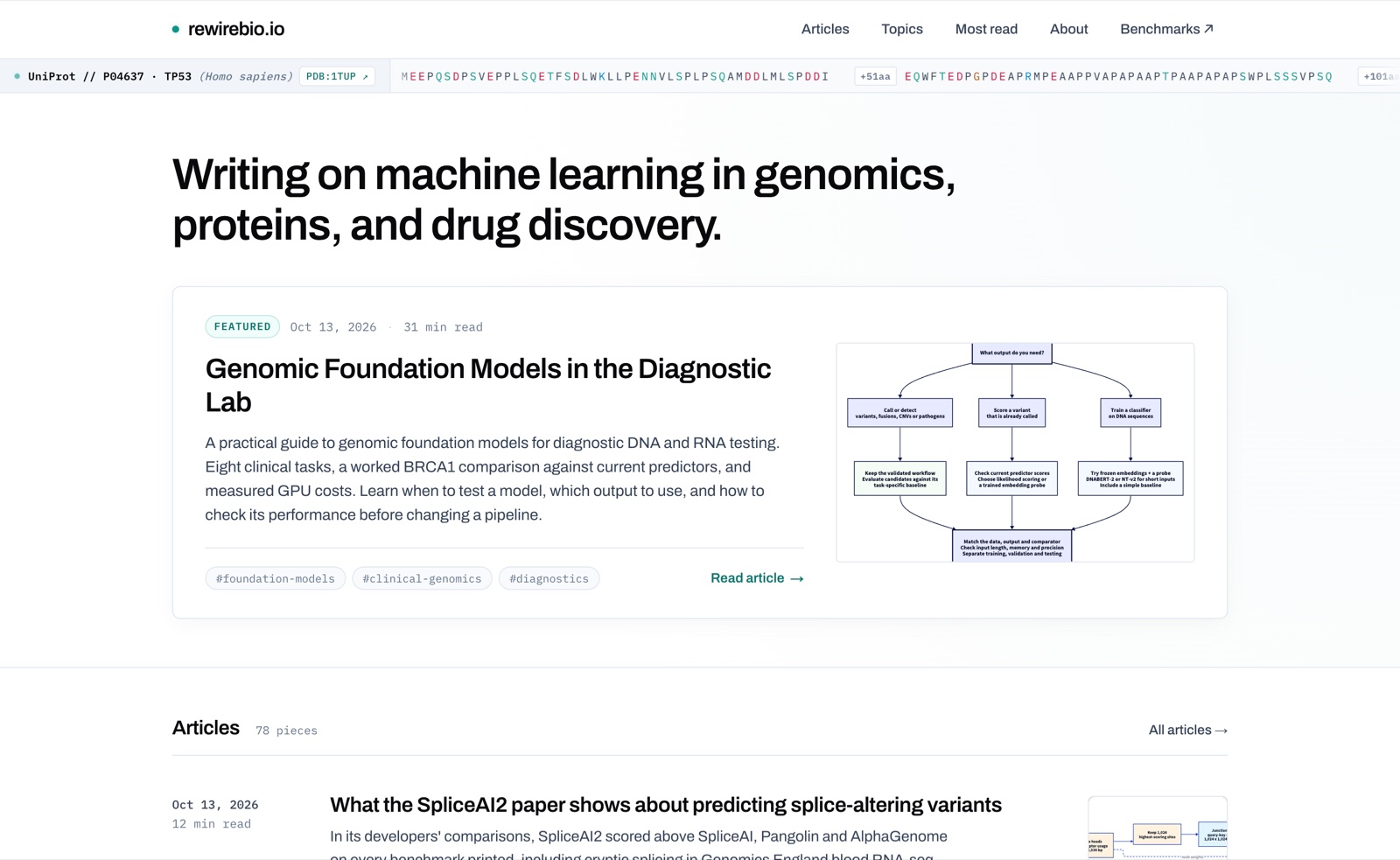
rewirebio.io has 78 articles on machine learning in genomics, proteins and drug discovery. Most look at what a paper actually shows, separating developer-reported numbers from independent ones. The featured piece is a practical guide to genomic foundation models in diagnostic labs, with a worked BRCA1 comparison and measured GPU costs.
Tools for agents
Two MCP servers came out of this work. genomics-mcp lets an AI assistant find public genomic datasets, read a bounded region from archive or local files, and look up variants and genes, with the source of every result. rdf-kg-mcp serves a versioned RDF knowledge graph read-only, which is how the benchmark database is exposed to agents.